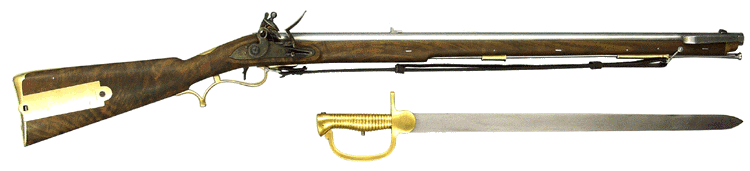
Before we get to the rifle it is worth noting that the principle weapon of the British infantry and all others throughout the Napoleonic Wars was that of the flintlock smoothbore musket. The British musket was know as the Brown Bess, most of which were obtained from the East India Company. The Board of Ordnance in 1797 ordered gunsmiths only to produce the 'India Pattern'.
The musket had a 39 inch barrel and could also be fitted with a bayonet which was a triangular section blade about 15 inches long (the musket could still be fired with a bayonet fixed although the rate of fire was reduced). This was an improvement on an earlier version which was plugged into the muzzle itself and rendered the musket unusable
Unlike most of the British Infantry, the 95th and a few others were issued with rifles. These battalions where entrusted with rifles because it was felt that the rifles greater accuracy and distance could make a marked impression on the outcome of any battle or skirmish. They where not adopted through out the British Army as a whole as they where slower to load and it was felt the quantity was better than quality.
Rifles were not a new invention during the Napoleonic wars, they had been around for over 150 years, in fact the first patent for a rifle was taken out by Arnold Rotsipen in 1634. The British army had dabbled with rifles before and the first mention of their use is in 1751, but all of these early rifles were imported and foreign made.
In 1775 the British Military bought some German rifles to trial, by the end of the year, Viscount Townsend, the master general, was satisfied with the trials and asked the government to obtain the Kings permission to purchase 1000 rifles. He did not wait for the response and in Jan 1776 sent a preliminary order for 200 rifles from Germany.
Negotiations were opened with the Birmingham trade for the remaining 800.
A rifle was sent to William Grice, gun maker, so he could make an official pattern. After this was approved, orders were placed for 200 each with Grice, Benjamin Willetts, Mathias Barker and Galton & Sons at 3 guineas per rifle.
The situation changed in 1776 when Capt. Ferguson of the 70th Regiment trialed his breech-loading rifle to the British military. The trial was a success. Firing at a rate of 4 shots per minute over a distance of 200yds. The master general decided no more muzzle loading rifles should be made ‘ as a new construction of Capt. Ferguson’s is approved.’
An order was placed for 100 of Ferguson’s rifles to the same gunsmiths making the muzzle loading rifles.
In March 1777 Capt. Ferguson was placed in charge of training 100 recruits from the 6th and 14th Regiments in the use of his rifle. In May 1777 these new riflemen arrived in America with a supply of green cloth for uniforms. They were involved in the attack on Brandywine Hill and played a major part in the success of the battle. They suffered heavy losses and Ferguson was wounded. Whilst Ferguson was recovering his rifles were disbanded and incorporated into the light companies of their old regiments. The Ferguson rifles we placed into store and further use or trials were not continued. The Ferguson did have some shortcomings, the stock was weak, it required some skill to operate, and it also had the disadvantage of not being able to use standard cartridges.
The only identifiable original Ferguson rifle from the original 100 made is in the Morristown National Park Museum. 49 inch long, 34 inch barrel, 0.68 inch calibre, rifled with 8 groves.
In Jan 1800 the adjutant general wrote to Col Coote Manningham placing him in command of a corps of detachments from 14 line regiments ‘ for the purpose of its being instructed in the use of the rifle.’
Trials of English and Foreign rifles took place at Woolwich in Feb 1800. Bakers rifle had 7 grooves with a quarter turn, most of the day had a three quarter turn. Baker argued it was easier to load and simpler out in the field.